





CAAS and NEA set up joint national programme and regional partnership
Singapore will strengthen aviation meteorological capabilities and regional collaboration to better tackle the effects of weather on aviation, as changes in weather patterns result in more flight delays and diversions, disruptions to airport operations and turbulence and other aviation safety concerns around the world.
National Aviation Meteorological Programme
The Civil Aviation Authority of Singapore (CAAS) and National Environment Agency (NEA) of Singapore have jointly set up a new multidisciplinary Aviation Meteorological Programme. The programme brings together aviation and meteorology experts as well as
aviation companies and unions to build research and development (R&D) and operations capabilities to better predict, mitigate and manage the effects of weather on air traffic control, airlines and airport operations.
The programme focuses on five priority areas, each addressing a critical weather phenomenon that affects aviation operations in Singapore and the region:
- Lightning. Singapore, located near the Equator, is amongst the world’s most lightning-prone countries. The Changi Climate Station observes lightning on nearly one in two days each year. Lightning poses safety risks to airside workers, disrupts airport operations and delays flights and baggage handling. Lightning risk notifications are currently issued based on a six-kilometre safety radius around Changi Airport. This poses operational challenges especially with the completion of Terminal 5, which will double Changi Airport’s footprint to 1,080 hectares. CAAS and NEA will aim to minimise the impact of cloud-to-ground lightning by improving lightning forecast precision, through initiatives including a more precise density map of lightning strikes at Changi Airport based on historical data, electromagnetic modelling of lightning interaction with aircraft, airport infrastructure and human beings and algorithms to enhance nowcasting of lightning events and zone-based lightning risk assessment. These will enhance worker safety, reduce downtime and enable more targeted zone-based approach to managing lightning risk.
- Turbulence. Severe turbulence incidents have risen globally, posing safety risks to passengers and crew. In September 2025, Singapore became the first State in the world to classify severe turbulence as a major in-flight risk, through CAAS’ National Aviation Safety Plan (2025-2027). Both agencies will seek to strengthen in-flight turbulence prediction and provide airlines with more timely, reliable and actionable weather information.
- Convective Weather. Weather-related flight delays and diversions have increased. Between January and November 2025, 55 flights were diverted from Changi due to bad weather, a sharp increase from the nine flight diversions in the same period a year ago. Convective weather in our region means that thunderstorms causing wind shear can occur and dissipate abruptly, making them hard to predict. CAAS and NEA will work towards improving convective weather forecasting to support real-time decision-making and optimise airport operations.
- Surface Winds. For safety reasons, CAAS air traffic controllers need to determine runway direction for aircraft to fly into the wind for take-off and landing. Rapidly shifting winds can result in multiple runway changes, reducing runway capacity and pose challenges to air traffic controllers and pilots. CAAS and NEA will improve the accuracy and timeliness of surface wind forecasts to better plan for runway changes and optimise runway use.
- Contrails. There is growing global attention on condensation trails (contrails) and their effects on global warming. CAAS and NEA will work on strengthening scientific knowledge on contrails particularly in the Asia-Pacific region where the atmospheric conditions differ from that in Europe and North America and data is limited. This will help inform future mitigation strategies and contribute to global policy development.
- An Aviation Meteorological Programme Steering Committee has been set up to direct the work of the programme. The Committee is co-chaired by Mr Han Kok Juan, Director-General of CAAS and Mr Wong Kang Jet, Chief Executive Officer of NEA. Other members of the Committee include senior representatives from Changi Airport Group, Singapore Airlines Limited (SIA), SIA Engineering Company, SATS, National Trades Union Congress (NTUC), and International Centre for Aviation Innovation (ICAI). The Committee will initiate projects to develop new concepts of operation and tools, and review policies to support their adoption if needed.
Regional Collaboration
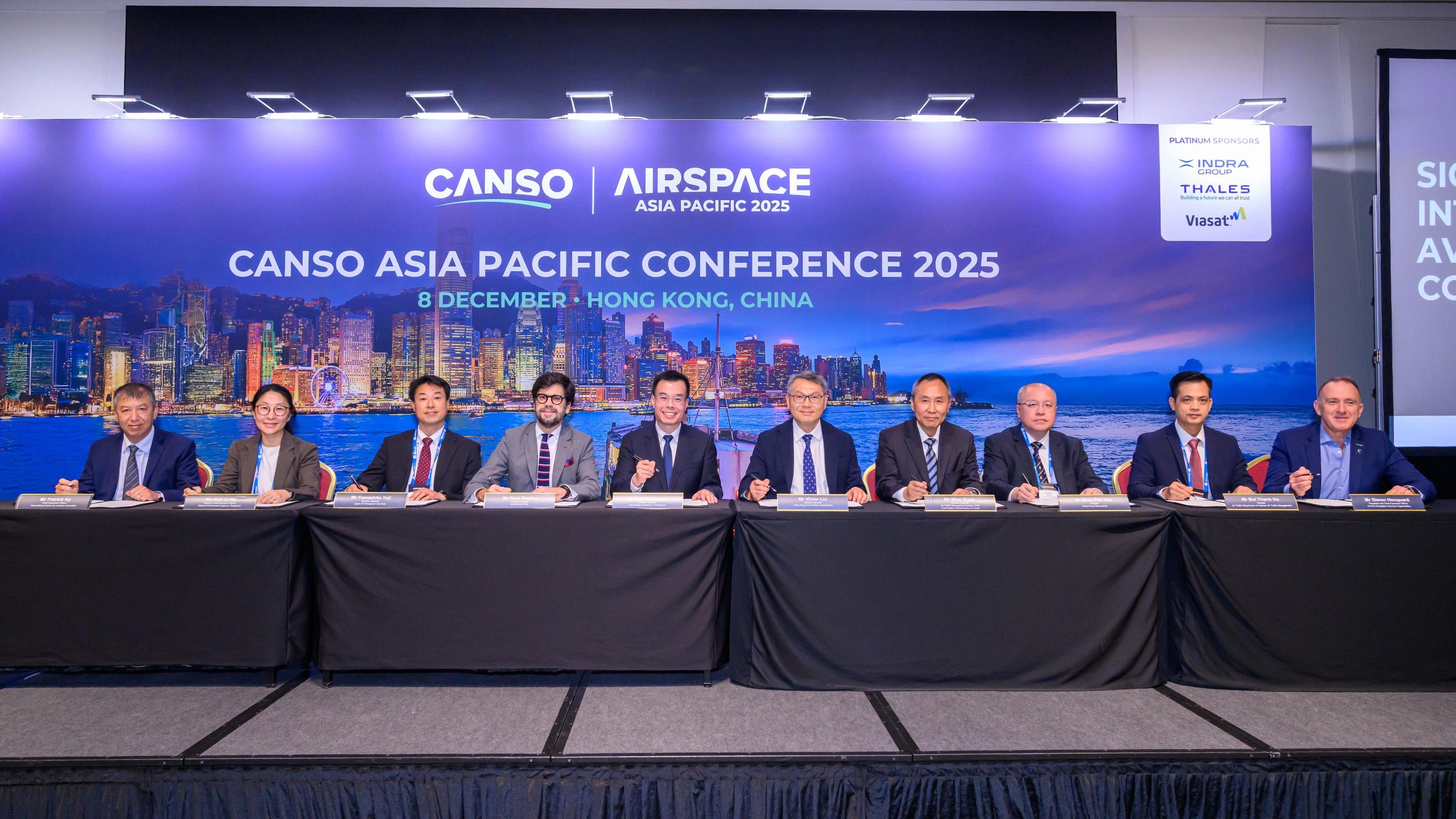
- As weather patterns and the effects of weather on aviation operations cross geographical boundaries, regional collaboration is needed for effective mitigation strategies. CAAS and NEA have initiated and signed a Letter of Intent to collaborate with six other air navigation service providers (ANSPs) and meteorological service providers (MET), the Civil Air Navigation Services Organisation (CANSO) and ICAI in R&D, capability development and data sharing.
- Under the Letter of Intent, the parties agree to:
- Strengthen regional integration between MET and Air Traffic Management (ATM) communities, including MET-MET and MET-ATM cooperation, to support more coordinated and resilient operations.
- Identify and pursue joint research and development priorities including:
- Weather phenomena that significantly affect ATM such as turbulence, low visibility, lightning, convection and wind shear
- Sustainability, including emissions reduction and contrail assessment; and
- Worker protection, including safety measures against adverse weather phenomena such as snow, extreme heat and lightning
- Enhance sharing and integration of weather data for better situational awareness and decision making.
- Build capability within MET and ATM communities to more effectively tackle the challenges posed by adverse weather and manage its operational impacts.
- The Letter of Intent was signed on 8 December 2025 in Hong Kong China at the CANSO Asia-Pacific Conference on “Seamless APAC Airspace – Aviation and Meteorology Integration”. This is the world’s first such conference, gathering aviation and meteorology professionals to foster collaboration and jointly address weather effects on aviation.
- Mr Han Kok Juan, Director-General, CAAS and Chair of the Asia-Pacific CANSO CEO Committee, said: “Changes in weather patterns are affecting aviation operations all over the world, including in Singapore. We take this seriously and are taking concrete steps to address it through better leveraging technology, including AI, integrating national aviation and meteorology expertise and regional partnership.”
- Ms Koh Li-Na, Director-General of the Meteorological Service Singapore, NEA said: “We welcome this initiative, which provides opportunities for MET service providers to improve the predictability of weather systems in the region and tailor solutions to support our aviation stakeholders.”
Annex A – Quotes from Letter of Intent Signatories
About the Civil Aviation Authority of Singapore
The mission of the Civil Aviation Authority of Singapore (CAAS) is to grow a safe, vibrant air hub and civil aviation system, making a key contribution to Singapore’s success. CAAS’ roles are to oversee and promote safety in the aviation industry, develop the air hub and aviation industry, provide air navigation services, provide aviation training for human resource development, and contribute to the development of international civil aviation. For more information, visit www.caas.gov.sg.
About the National Environment Agency
The National Environment Agency (NEA) is the leading public organisation responsible for ensuring a clean and sustainable environment for Singapore. Its key roles are to improve and sustain a clean environment, promote sustainability and resource efficiency, maintain high public health standards, provide timely and reliable meteorological information, and encourage a vibrant hawker culture. NEA works closely with its partners and the community to develop and spearhead environmental and public health initiatives and programmes. It is committed to motivating every individual to care for the environment as a way of life, in order to build a liveable and sustainable Singapore for present and future generations. For more information, visit www.nea.gov.sg
For media queries, please contact: Ms Linda Wang
Manager (Corporate Communications) Mobile: +65 9785 6548
Email: linda_wang@caas.gov.sg
Ms Melanie Wong
Manager (Corporate Communications) Mobile: +65 8536 8678
Email: media@nea.gov.sg